2027 Could Be the Hardest Year to Get Hired: What to Do Now
AI is already shrinking entry-level hiring, and 2027 could be the hardest year yet for freshers. The data, the jobs of the future, and what to do now.
5 min read
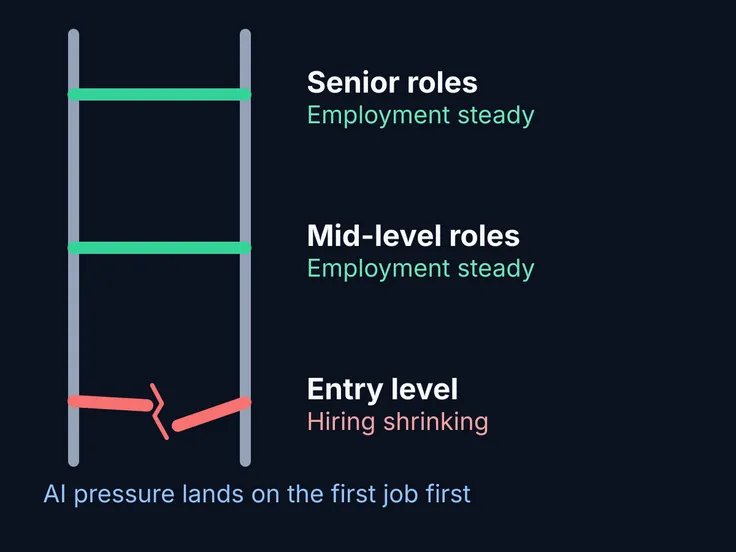
If you graduate in 2027, landing your first job could be harder than it has been for any batch in years. AI now does much of the routine work freshers were hired to learn on, and companies have responded by hiring fewer juniors, not by firing seniors. The data from 2025 and 2026 shows the damage growing every time it’s measured.
Here’s what the data says about the AI job market in 2027, as of October 2026, and what to do about it.
Is AI really reducing entry-level jobs?
Yes. The strongest evidence comes from a Stanford Digital Economy Lab study by Erik Brynjolfsson, Bharat Chandar and Ruyu Chen, which tracks millions of US workers through ADP payroll data. In its August 2026 update, employment of 22 to 25 year olds in the most AI-exposed jobs was about 19% below where it would be had it kept pace with less-exposed peers. Each new version of the study has shown a wider gap:
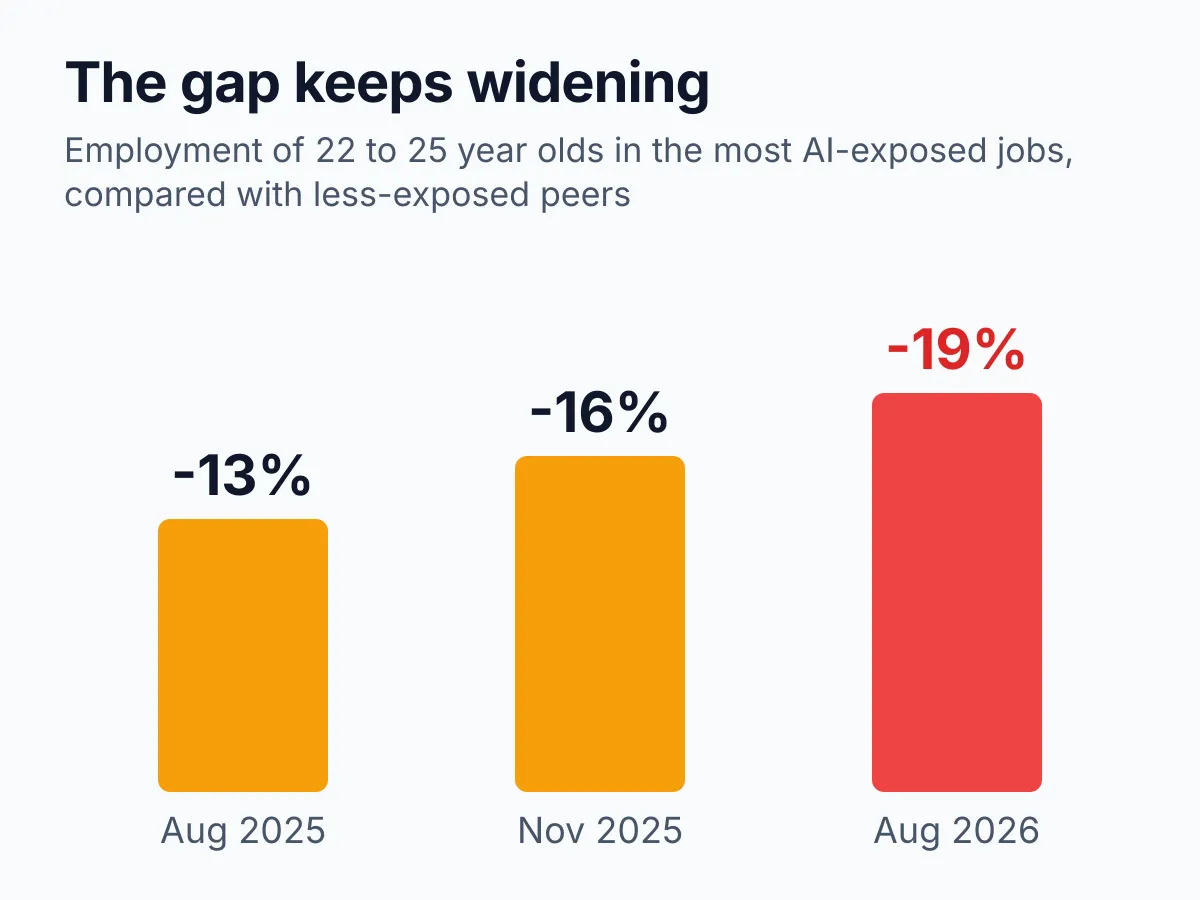
Two findings matter most for freshers:
- Experienced workers show no comparable gap. Companies kept their senior people.
- The drop comes from hiring, not layoffs: fewer young workers were hired, rather than more being let go.
So the risk isn’t losing a job you have. It’s never getting the first one.
SignalFire’s 2025 State of Talent report found new-graduate hiring at the largest US tech companies down 50% from 2019. In India, TCS onboarded about 10,000 freshers in the July to September 2026 quarter, and its HR head said the company is “hiring for demand”. That phrase sums up the shift: fewer offers, made later, only to people who are useful sooner.
Why 2027 could be harder than 2026
Four trends point the wrong way for the 2027 batch:
- The gap is still widening. The Stanford authors say it kept growing through mid-2026.
- AI keeps getting better at first-year work, such as boilerplate code, small bug fixes and support tickets.
- Teams are learning to ship with fewer juniors. Every team that manages it in 2026 has less reason to hire more in 2027.
- The queue is longer. Graduates who weren’t placed in 2026 will still be applying when you are.
You’re also the first batch to spend all four years of college after ChatGPT launched in November 2022. And the people building AI aren’t reassuring: in May 2025, Anthropic CEO Dario Amodei warned that AI could eliminate half of entry-level white-collar jobs within one to five years. 2027 falls inside that window.
Will AI cause a job market collapse in 2027?
Probably not a global one. The Stanford authors see no widespread, economy-wide job displacement from AI, and a Yale Budget Lab analysis found no discernible disruption to the overall US labour market 33 months after ChatGPT.
But averages don’t get anyone hired. An economy can add jobs while the junior openings in your field shrink. If 2027 brings a collapse, it will be personal, not global: it will hit graduates whose only skill is something AI now does cheaply.
Which jobs will AI replace first?
Desk jobs, which is where most freshers start. Anthropic’s March 2026 report, Labor market impacts of AI, compared how much of each job AI could theoretically do with how much it already does, based on real Claude usage. In computer and math jobs, AI could handle 94% of tasks but covers only 33% so far.
That gap is the warning for 2027. Anthropic’s researchers expect real usage to keep growing toward what AI can do, and found early signs that hiring of 22 to 25 year olds into the most exposed jobs has slowed.
A rule of thumb: if a task can be fully described in a ticket and checked in five minutes, assume AI will be doing it by the time you join.
What are the jobs of the future?
The fastest-growing jobs to 2030 are technology roles led by big data, fintech and AI, while the fastest-shrinking are clerical. That’s the outlook from more than 1,000 employers surveyed for the WEF’s Future of Jobs Report 2025:
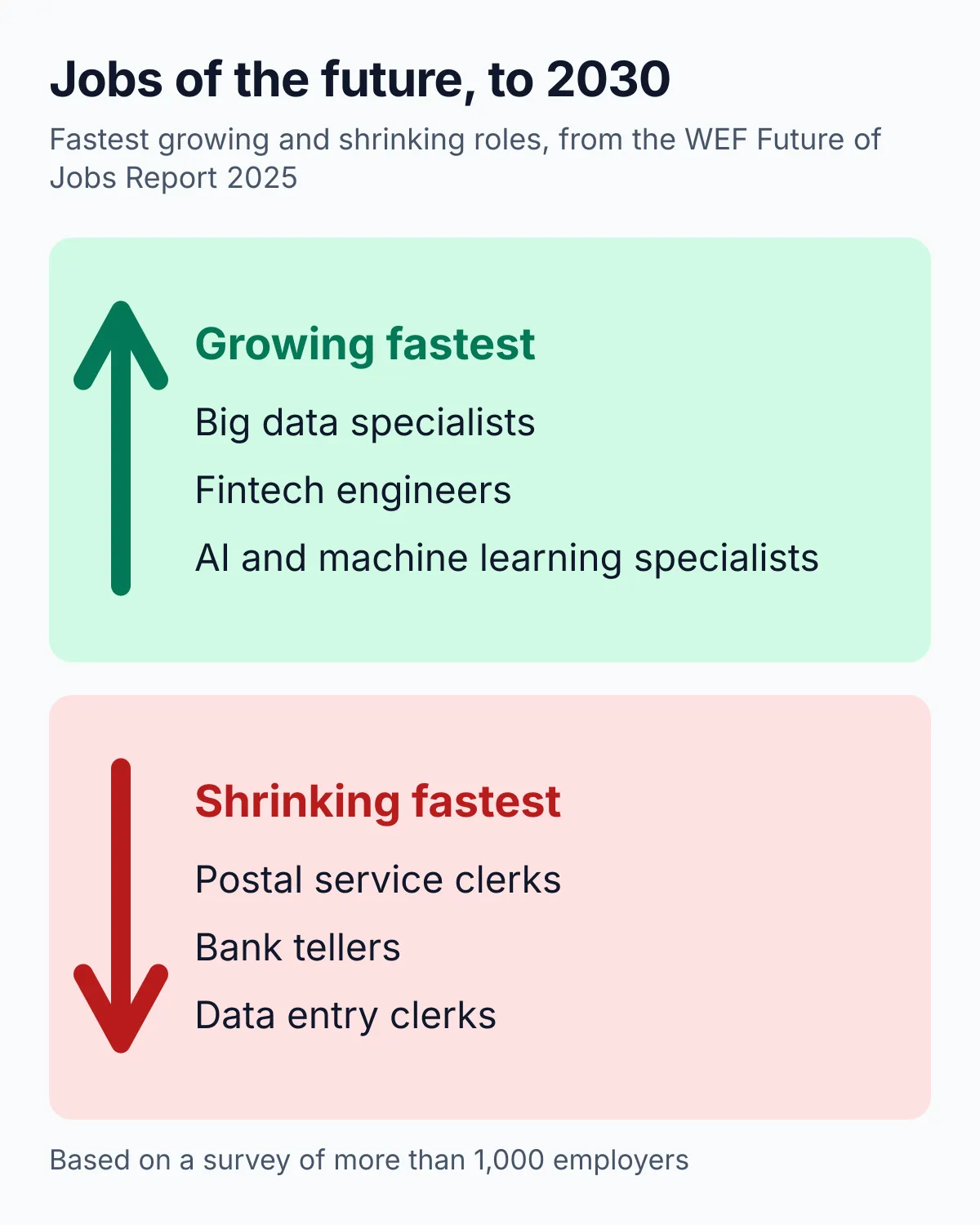
The growing jobs build, secure and run AI systems; the shrinking ones are the routine tasks those systems automate.
Which skills should you learn for 2027?
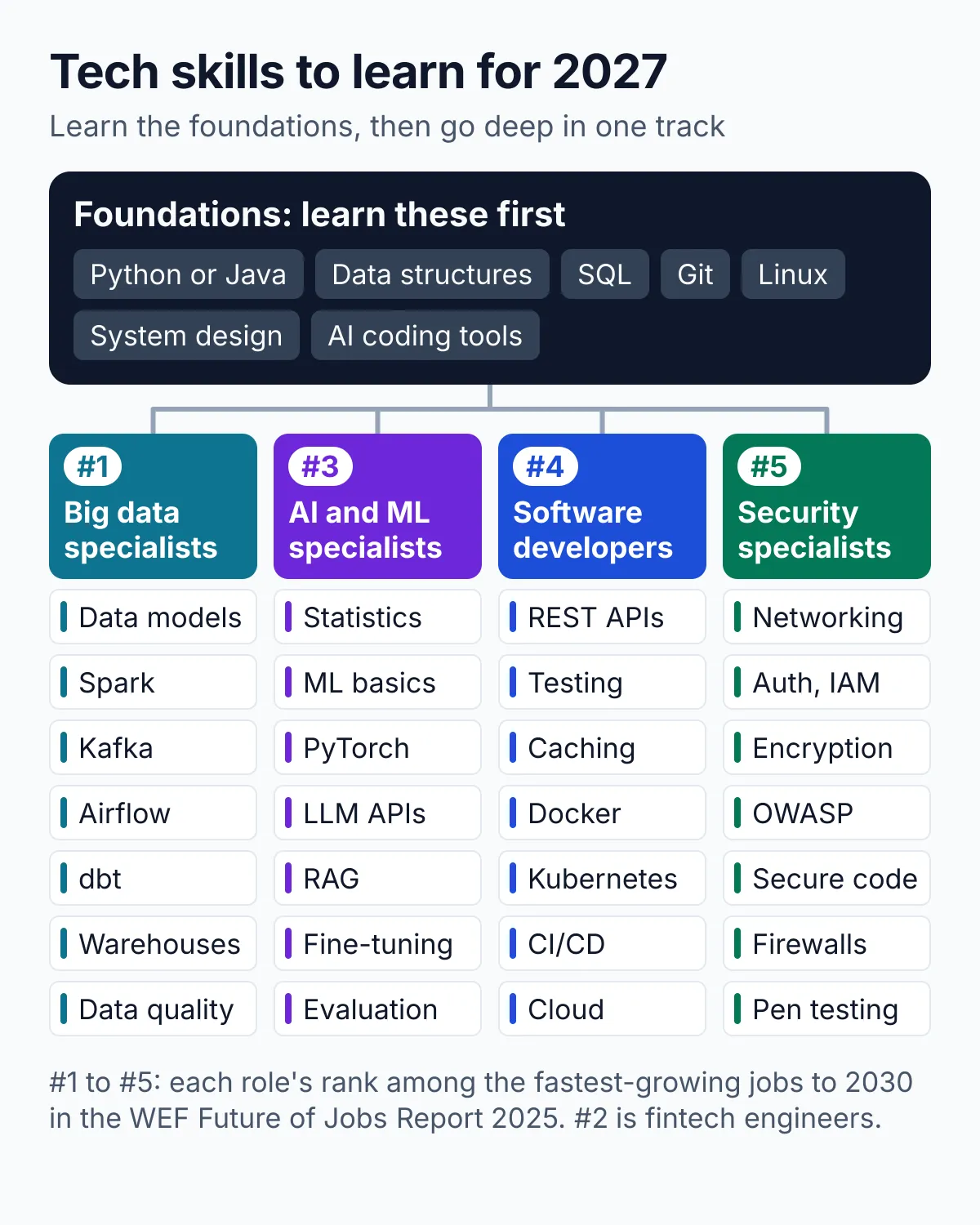
Learn the foundations, then go deep in one track. Each track below leads to one of the WEF’s five fastest-growing jobs to 2030, and the same survey ranks AI and big data, then networks and cybersecurity, as the fastest-growing skills:
What should the 2027 batch do now?
Start this month. If your resume lists courses rather than projects, or your only plan is campus placements, begin here:
- Use AI every day, and note where it’s wrong. “I use Copilot” isn’t a skill. “It suggested this, it was wrong, and my test caught it” is.
- Build one project that runs like production: deployed, tested and logged, with a README explaining your decisions. This Spring Boot checklist shows what that means.
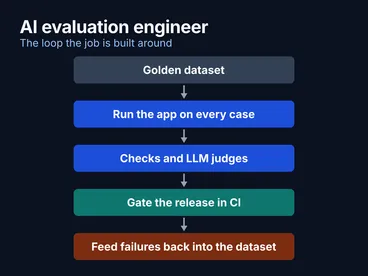
- Learn to check AI output. Testing and evaluation matter more as AI writes more code. The AI evaluation engineer roadmap is one path.
- Pick one track from the map above, and build your project in it.
- Get real experience before you graduate: internships, open source, or work for a real user.
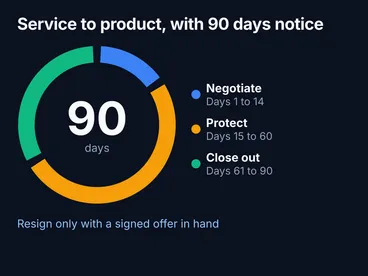
- Apply off-campus from day one to product companies, global capability centres and startups, and have a plan for not being placed by graduation.
FAQ
Will AI replace software engineers by 2027?
No. Software developers are among the WEF’s fastest-growing jobs. AI is replacing the routine part of the junior role, which is why the bar for freshers keeps rising.
Is computer science still worth it for the 2027 batch?
Yes, but the degree alone no longer gets you hired. Proof that you can build, check and ship work does.
The bottom line
AI probably won’t crash the global job market in 2027. It doesn’t need to. It’s already narrowing the entry-level door, and the 2027 batch is the first to graduate entirely into that market. You have months, not years, to become someone a company would still hire when AI can do the routine work.