Service to Product Company Switch With a 90-Day Notice Period
A clear playbook for moving from a service company to a product company when you have 90 days notice: when to resign, buyout or early release, and the exit kit.
10 min read
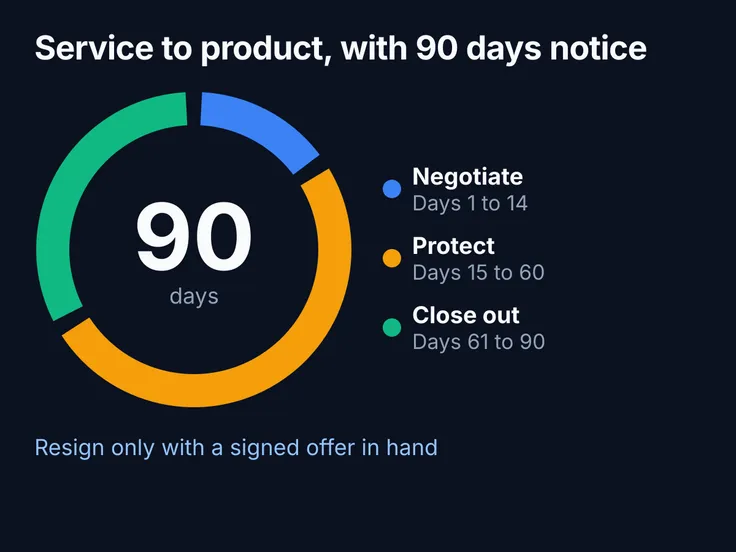
You can switch from a service company to a product company with a 90-day notice period, but only if you sequence it: interview while you’re still employed, resign only after you hold a signed offer, then use the 90 days in three phases. Spend the first two weeks negotiating an earlier exit, the middle stretch protecting the new offer, and the last month closing out cleanly with every document you’ll need.
Most of the horror stories in notice-period threads on r/developersIndia come from breaking that order: resigning without an offer, an offer withdrawn halfway through the notice, or leaving without a relieving letter. This guide is the playbook those threads don’t give you.
Should you resign before you have an offer?
Usually not. Resigning first puts you on a 90-day clock with nothing at the end of it, and if the search runs long you either withdraw your resignation, if your employer allows it, or leave with no job.
The case for resigning first is narrow. It makes sense when you have savings for six months or more, when your notice period alone is blocking offers you would otherwise get, or when your health or situation means staying is worse than the gap. If that’s you, decide it on purpose. For everyone else, interview while employed and treat the notice period as a negotiation problem, not a reason to quit early.
How to talk about a 90-day notice period in interviews
Say it plainly, say it early, and pair it with what you can do about it. Hiding it until the offer stage wastes everyone’s time and makes the conversation harder.
Some product companies screen out long notice periods, especially for roles they need filled quickly. You can’t change that, but you can make it a smaller problem:
- Lead with the date, not the number. “I can join by 15 January” lands better than “90 days”.
- Say what’s negotiable. If your contract allows a buyout or early release, say you’ll ask for it.
- Target teams that plan ahead. Mid-size product companies and teams hiring for a planned roadmap can often wait; urgent backfills usually can’t.
A reply to a recruiter can be this short:
My notice period is 90 days. My contract allows early release at the
company's discretion, and I'll request it as soon as I resign. Realistic
joining window: 6 to 12 weeks from the offer date. If you need someone
sooner, I'd rather know now.
The 90 days, phase by phase
Treat the notice period as a project with milestones, not a waiting room.
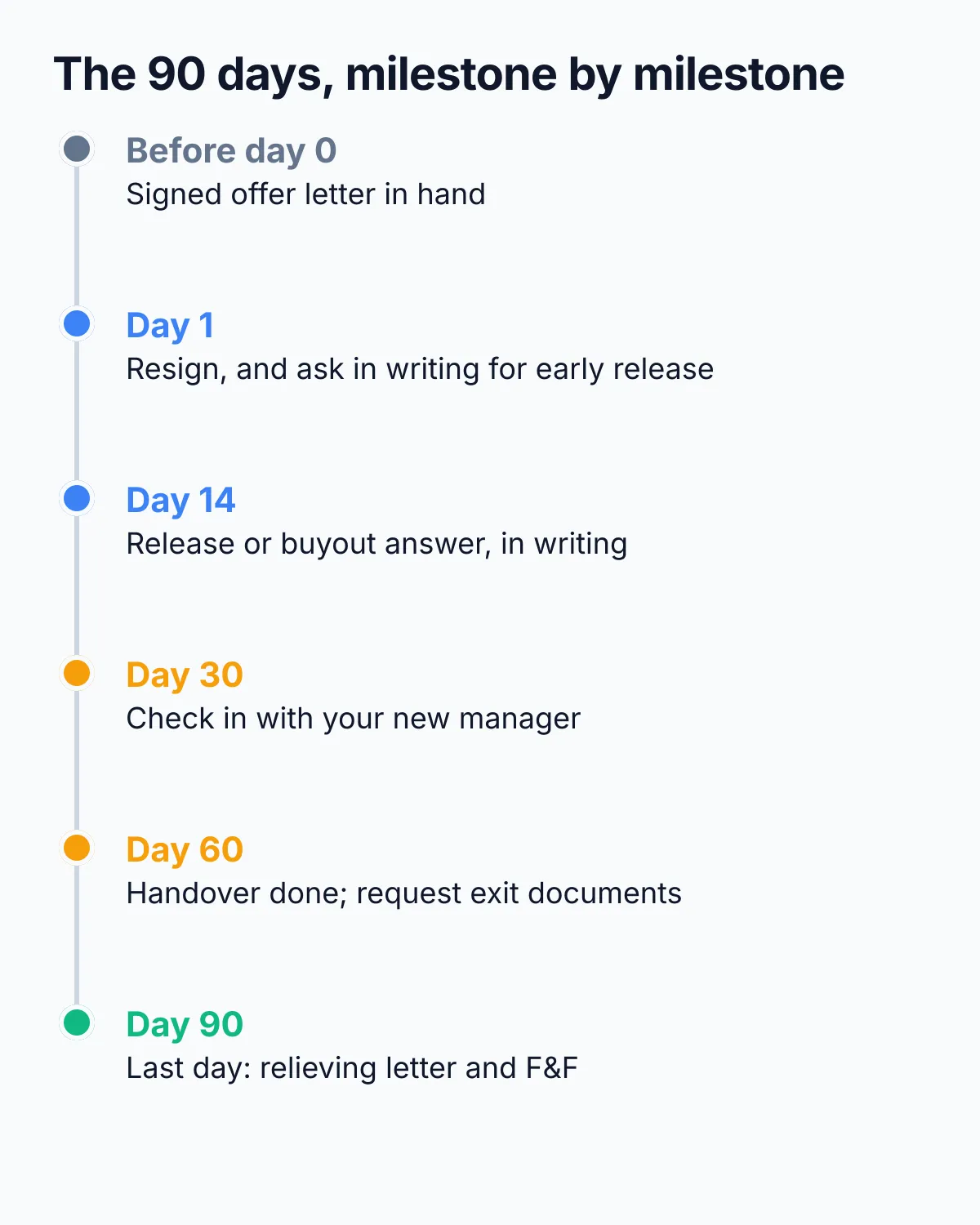
Days 1 to 14: negotiate
Resign in writing, and ask for early release in the same email or the next one. Make it easy to say yes by offering a concrete handover plan:
Subject: Resignation and request for early release

I'm resigning from my role, effective today. My contractual last working
day would be 6 January. I'd like to request release by 5 December.

Handover plan:
- Week 1-2: document the payment-reconciliation module and its runbooks
- Week 3: pair with <colleague> on on-call and the release process
- Week 4: transfer access and close open tickets

If early release isn't possible, I'm open to a buyout of the remaining
notice as per my contract. Could you confirm either option in writing?
Get every answer in writing. A manager saying “yes, should be fine” in a meeting is not a release date. If they say no, ask what would change the answer, such as a backfill joining or a module handed over.
Days 15 to 60: protect the offer
This is where switches go wrong. Offers do get withdrawn during long notice periods, through reorganisations, budget freezes or a team that stopped waiting, so stay visible without being needy:
- Lock the joining date. Ask the new employer to confirm it in writing, and update it in writing if it moves.
- Check in every few weeks. A short message to your new manager or recruiter keeps you from becoming a name in a spreadsheet.
- Keep one backup warm. You don’t need to keep interviewing hard, but don’t decline every other process the day you sign.
- Decide on counteroffers before one arrives. If you left for the work and the learning, a raise to stay rarely fixes either. Deciding in advance makes the conversation shorter.
Days 61 to 90: close out
Finish the handover, then focus on paperwork. The relieving letter matters more than it seems, because product companies’ background verification usually checks previous employment, and a missing or disputed exit is slow to fix after you’ve left.
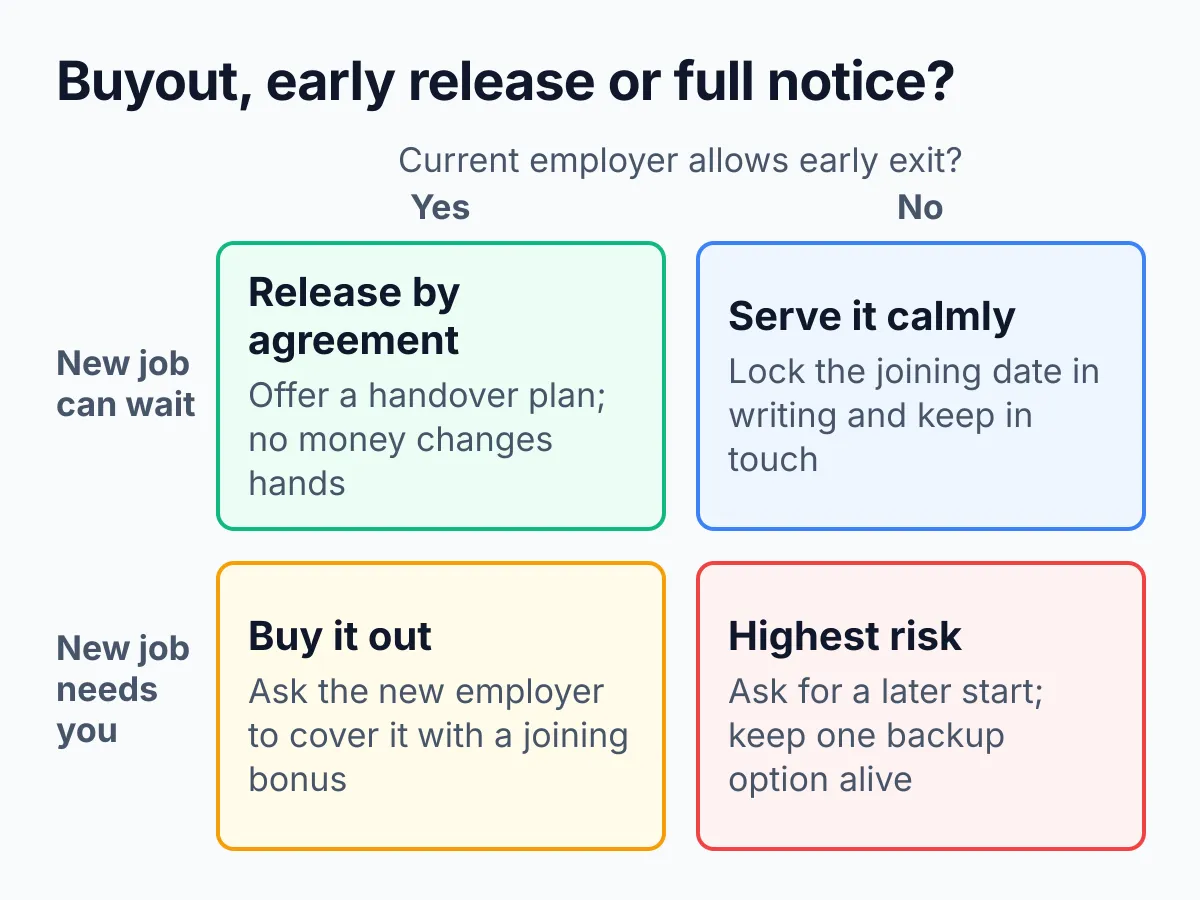
Buyout, early release or full notice?
Which one you use depends on two things: whether your current employer will let you go early, and whether the new employer can wait.
How a buyout is usually calculated
A buyout is money you pay, usually recovered from your final settlement, in place of serving the remaining notice. Your contract decides the formula, so read it before you negotiate. The two common variants are:
Buyout = (monthly basic pay / 30) x remaining notice days
Buyout = (monthly gross pay / 30) x remaining notice days
The second can be roughly twice the first, depending on how much of your pay is basic, so check which your contract uses. Also check whether your employer must accept a buyout or can choose to refuse it. Many contracts make early release or buyout the employer’s decision.
If the new employer wants you sooner, ask them to cover the buyout, usually through a joining bonus. Get it in the offer letter, and expect it to be taxed as salary, with a clawback if you leave within a year or so. Read that clause too.
What the law does and doesn’t say
This is general information, not legal advice. Your contract governs most of this, and an employment lawyer can read it for you if the stakes are high.
- Notice periods come from your contract, along with company policy and any certified standing orders that apply. There is no single statutory 90-day rule for software engineers.
- Courts don’t make people keep working. Indian law doesn’t specifically enforce contracts of personal service (Specific Relief Act, 1963). What an employer can do is recover what your contract allows in place of the remaining notice, and in practice the leverage it uses is the relieving letter and your final settlement.
- Non-competes after you leave are generally void. Section 27 of the Indian Contract Act, 1872 voids agreements in restraint of trade, and the Supreme Court in Percept D’Mark v. Zaheer Khan (2006) held that a restrictive covenant extending beyond the term of the contract is void. Confidentiality obligations still apply.
- Restrictions during employment are a different matter. Until your last working day you are still employed. Don’t start the new job early: overlapping employment can surface in background verification and in your PF service history, and it can breach your current contract.
The exit kit: documents you need
Collect these before or around your last day. Some, like the PF transfer and Form 12B, happen after you join.
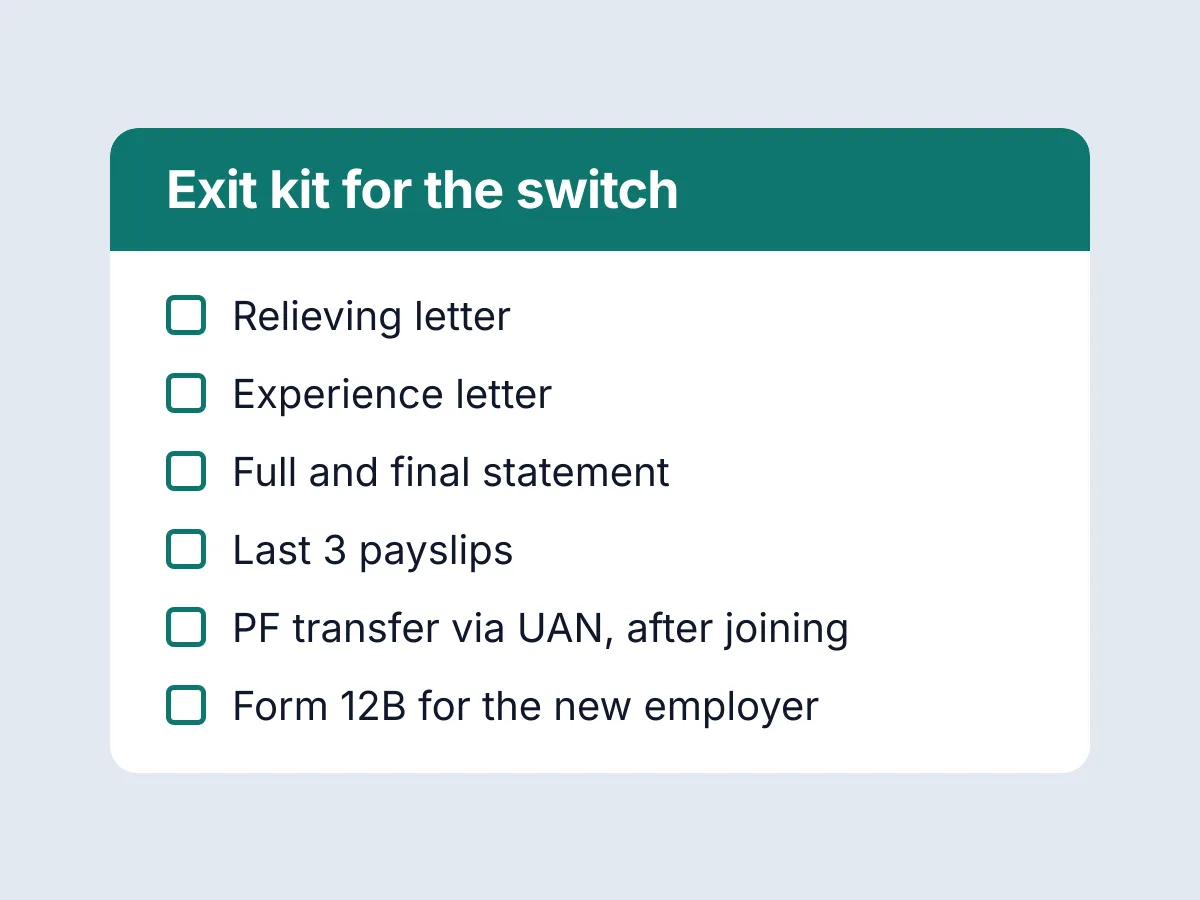
- Relieving letter and experience letter: confirm your dates and role. Background verification often asks for them.
- Full-and-final statement: shows pay, leave encashment and any recoveries, including a buyout. Check it line by line.
- Payslips: keep the last few. New employers sometimes ask for them to verify pay.
- PF transfer: after you join, log in to the EPFO member portal with your UAN and file the online transfer request (Form 13), then have the employer you chose attest it.
- Form 12B: gives your new employer your earlier salary and TDS for the financial year, so they deduct the right tax.
- Form 16: your previous employer issues it after the financial year ends. You’ll need it, along with the new employer’s, for your tax return.
Before your last day, also return company assets against a written acknowledgement and remove personal files from company devices.
Use the notice period to start well
Ninety days is also preparation time for a product company, where you’re usually expected to own a service end to end. Two things help most in the first months:
- Production habits: validation, error handling, configuration and health checks. This Spring Boot checklist is a quick refresher.
- The new stack’s core pieces: if the team runs event streaming, learn how Kafka consumer groups divide work before day one.
Common mistakes and what they look like
- Resigning on a verbal offer. The written offer never arrives, and your notice clock is already running.
- Accepting “we’ll see” as an answer. Day 80 arrives with no release decision. Ask for written answers by day 14.
- Going silent with the new employer. You hear about a reorganisation from someone else, a week before joining.
- Signing a buyout without reading the clawback. The joining bonus has to be repaid if you leave early.
- Skipping the relieving letter to leave faster. Background verification at the new job stalls on an unverified exit.
FAQ
Can my company refuse to accept a buyout?
It depends on your contract. Many contracts make early release or buyout the employer’s decision. If yours does, you can ask and negotiate, but you can’t force it. Read the exact clause, and get every answer in writing.
Can I withdraw my resignation if the new offer is cancelled?
You can ask, but your employer doesn’t have to accept it. This is the strongest reason to keep in touch with the new employer during the notice period, and to keep one backup option warm.
Will product companies reject me for a 90-day notice period?
Some will, especially for urgent roles. Many will wait for the right candidate, particularly when you state a clear joining date and what’s negotiable. Applying to teams that hire on a planned roadmap improves your odds.
Do I pay tax on a joining bonus that covers my buyout?
Yes. A joining bonus is part of your salary for tax purposes, whatever it’s meant to cover, and a clawback usually applies if you leave within the period the offer letter states.
Bottom line
A 90-day notice period slows a switch down but doesn’t block it. Get the signed offer first, ask for early release in writing in the first two weeks, keep the new offer alive through the middle, and leave with your relieving letter and settlement in hand. The notice period is a negotiation with deadlines, not three months of waiting.